Case study
Performance Optimization Consultant
Profiled every scene of People of Note to build a data-driven roadmap for smooth performance on Steam Deck and other handhelds.
Iridium Studios
12/2024 - 06/2025
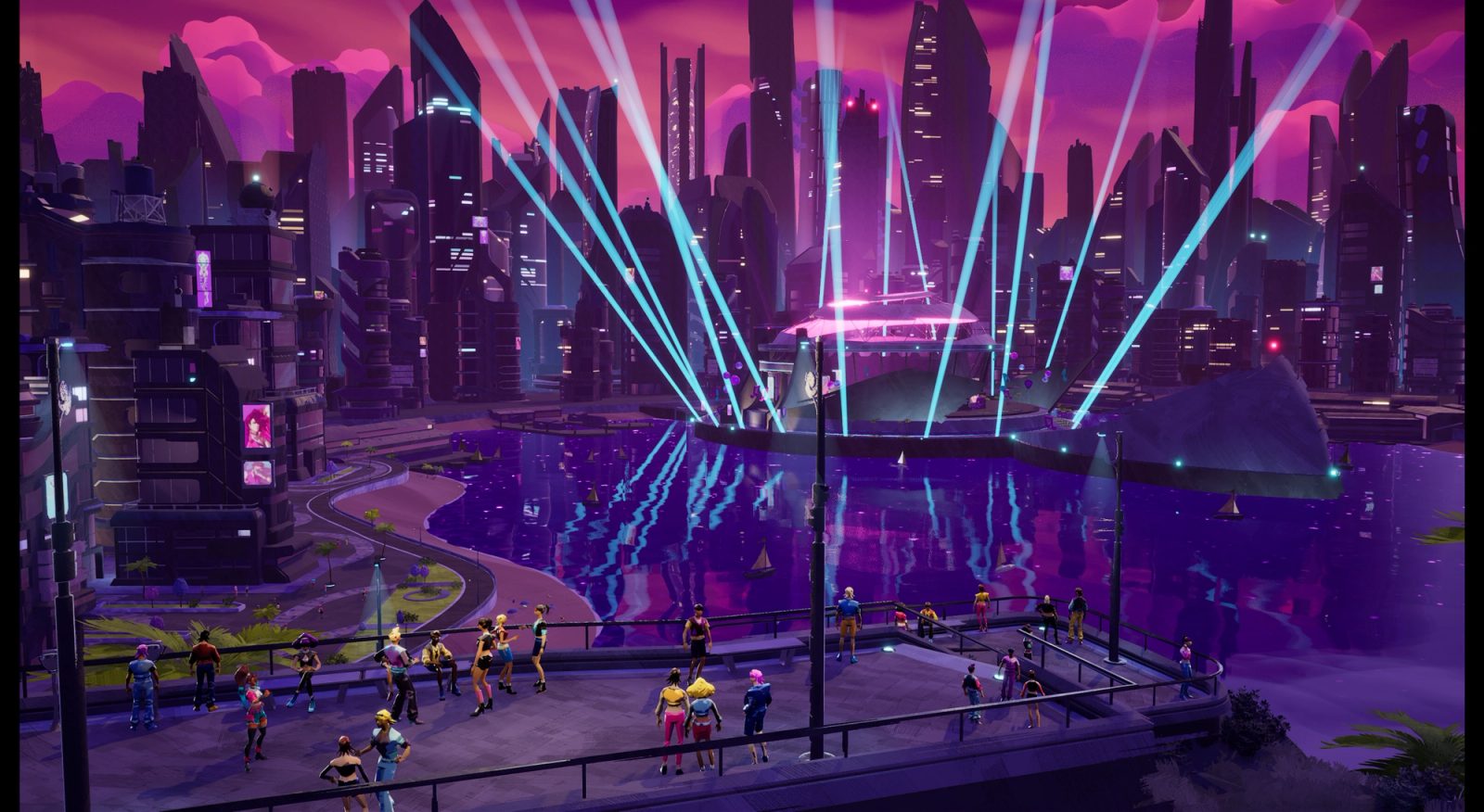
Iridium Studios
Performance Optimization Consultant
December 2024 – June 2025
Summary
I consulted with Iridium Studios on People of Note to help get the game running well on Steam Deck. The work started as a favor to the team and became a contract. I profiled all 148 scenes in the game using the same process, traced the most expensive areas back to specific materials, lights and effects, verified my findings, and delivered a prioritized list of optimizations to the team. Most of the cost came from a few recurring sources, lighting, water and overdraw, so a small number of changes had a large impact on game performance. People of Note shipped in April 2026 running at a stable 40 FPS on Steam Deck without changes to the art direction.
Profiling Every Scene
Captured every playable scene with the same process so results could be compared across all 14 worlds.
- Set up a shared Trello board with a column for each world and a card for each scene, with 226 captures attached by the end of the project.
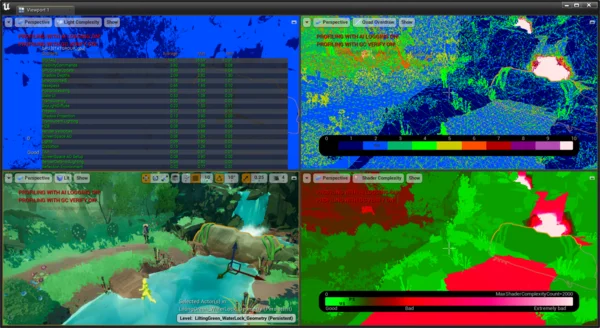
- Captured each scene in four Unreal view modes: lit, light complexity, shader complexity and quad overdraw.
- Recorded
stat unit,stat gameandstat renderthreadfor each scene to determine whether it was GPU, game thread or render thread bound.
Tracing Costs with RenderDoc
Used RenderDoc frame captures on the scenes flagged in the survey to find the specific cause of each cost.
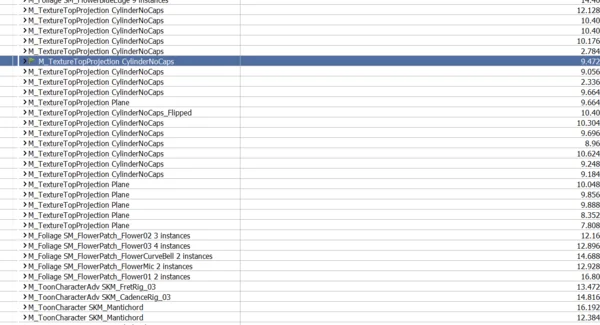
- Stepped through individual draw calls to identify which materials, meshes and effects were responsible.
- Measured how many times each was drawn per frame and the cost of each draw.
- Documented findings on each scene card so the team could review the data directly.
Verifying the Analysis
Working as a solo consultant, I used generative AI as a rubber ducky to review my analysis. I walked through the Unreal debug data and RenderDoc captures to check that I was reading them correctly, that the optimization I recommended was the best option, and that I hadn’t overlooked a detail. All measurements came from Unreal and RenderDoc.
Recurring Costs
Tagged each scene with its main costs, which showed that most expensive scenes shared the same few problems.
| Recurring cost | Where it appeared |
|---|---|
| Dynamic lighting | Most worlds, especially Shred76 and Chordia |
| Water material | Chordia, Choral Reef, Synesthesian Deep |
| Particle and fog overdraw | Durandis, Synesthesian Deep, Whirl Generation |
| Per-frame overhead | Video playback, UI |
Prioritized Recommendations
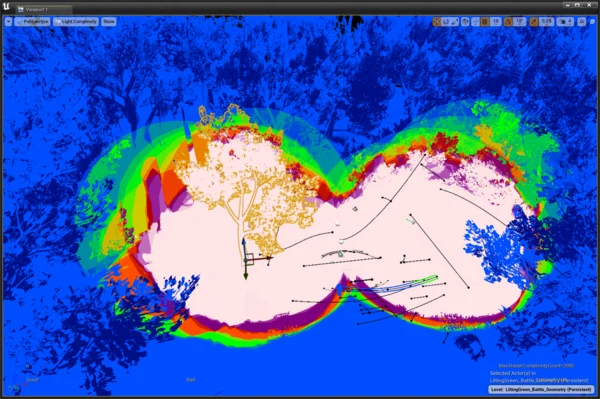
Ordered recommendations by cost-to-benefit, starting with changes that had no visual impact. Changes that affected the art style, such as the painterly projection material, were flagged for the team to review.
Key findings
- Set Bink video to stream instead of preload, reducing per-frame overhead from 300 µs to 20 µs.
- Disabled a Bink video material still rendering on a UI object for a ~2.5% frame rate increase.
- Converted a volumetric light material from lit to unlit, reducing it from 123 to 98 instructions with identical visuals.
- Culled off-camera root meshes in Lilting Green, reducing shadow cascades from four to two and frame time from ~9.5 ms to ~8.7 ms.
- Removed dynamic lights from the firefly particle system, bringing light complexity back to neutral.
- Recommended splitting the 673-instruction water material into a shoreline material with depth effects and an open water material without them.
- Recommended CPU optimizations: longer tick intervals for background Blueprints, vertex animation for large crowds, and precompiling shaders that were compiling on first use.
Outcomes
- People of Note launched April 7, 2026 and runs at a stable 40 FPS on Steam Deck at recommended settings, with 3 to 3.5 hours of battery life, according to Steam Deck HQ.
- The game is rated Steam Deck Playable due to small UI text, not performance.
- Iridium’s team implemented and shipped the changes.
Summary
This project reinforced the value of measuring every scene the same way before optimizing. Surveying the whole game made recurring problems visible that a single scene would not have shown, and ranking changes by cost-to-benefit gave the team a clear plan they could act on while keeping the art direction.